

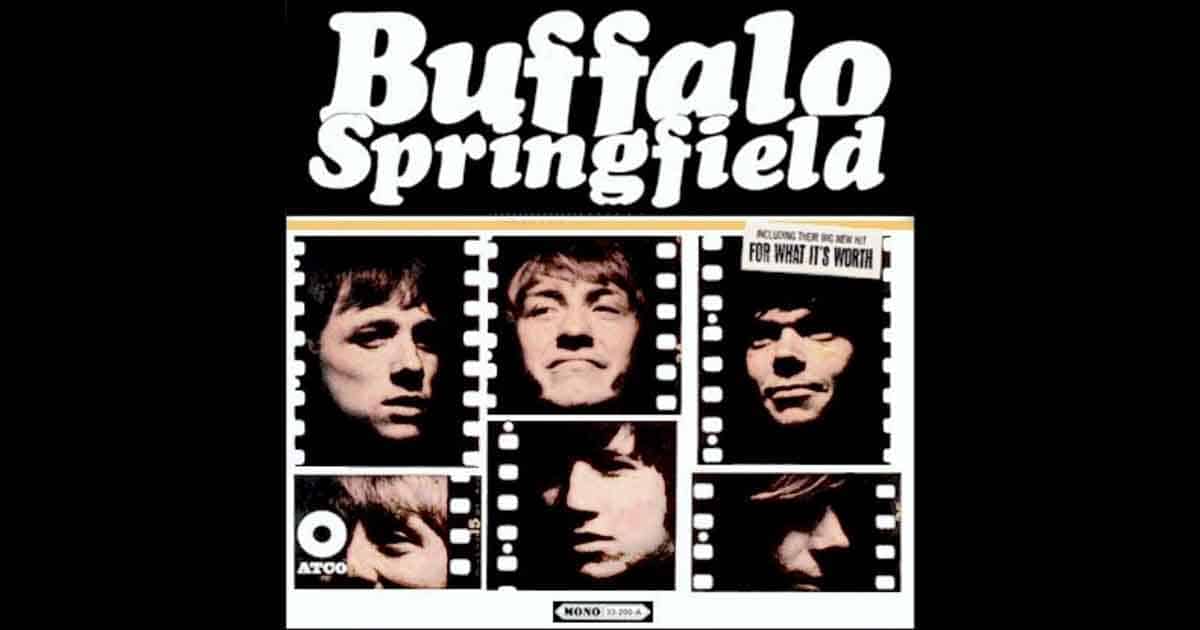
Over five decades ago, “For What It’s Worth” was released by Buffalo Springfield as a single on Atco Records. Not only did it peak at No. 7 on the Billboard Hot 100 chart in the spring of 1967, but it quickly became a well-known protest song.
According to Broadcast Music, Inc. (BMI), the song’s publishing house, “For What It’s Worth,” has been played eight million times on both radio and TV stations since its release. In 2014, it came in at No. 3 on Rolling Stone’s The Best Protest Songs poll.
“The way it’s written, it’s so open to interpretation,” Heart’s Ann Wilson said, who released a cover in 2015 on her first EP. “It’s so open that it’s brand new today. You can apply the song to any situation in any decade.”
But contrary to what most people believed, “For What It’s Worth” was actually not written as an anti-war song.
The Story Behind One of The Most Enduring Protest Songs
Written by Buffalo Springfield guitarist Stephen Stills, “For What It’s Worth” was inspired by the Sunset Strip curfew riots – also known as the “hippie riots” – in 1966 that took place between young people and police on the Sunset Strip in West Hollywood, California.
The situation at that time was pretty tense. It started when a number of clubgoers descending on the Strip have increased, irritating the residents and upscale boutiques due to the late-night traffic congestion it caused.
In response, they sent a petition for the city to pass local ordinances, putting a stop to loitering and enforcing a strict curfew on the Strip. The Los Angeles Police District then instigated a 10 PM curfew for anyone under eighteen. As expected, this didn’t go well with the young music fans. They find the new laws infringing upon their civil rights.
So, on November 12, 1966, it was announced on several local radio stations that there would be a protest outside the Pandora’s Box club, which was located on the corner of Sunset Boulevard and Crescent Heights. Fliers were also being distributed on the Sunset Strip, inviting people to join demonstrations.
For You
Later that evening, as many as 1,000 young demonstrators gathered to protest against the curfew’s enforcement. Although the rallies started peacefully, trouble eventually broke out.
“The commercial merchants on Sunset Boulevard in a certain area decided that the element of young people on the street every night was not conducive to commercial enterprise,” Stills said during his 1971 interview. “A bunch of kids got together on a street corner and said we aren’t moving. About three busloads of Los Angeles police showed up, who looked very much like storm troopers. And I looked at it and said, ‘Jesus, America is in great danger.'”
The unrest went on the next night and occasionally throughout the rest of November and December. This forced some clubs to shut down just within weeks.
“There’s battle lines being drawn. Nobody’s right if everybody’s wrong. Young people speaking their minds. Getting so much resistance from behind. It’s time we stop, hey, what’s that sound. Everybody look what’s going down,” the song goes.
Indeed, this eerily quiet song captured the uneasy mood of the moment. It launched the band to stardom and has remained one of the most enduring protest songs in ages. However, Stills had very different feelings than many might expect.
“We didn’t want to do another song like ‘For What It’s Worth,'” he said. “We didn’t want to be a protest group. That’s really a cop-out, and I hate that. To sit there and say, ‘I don’t like this, and I don’t like that’ is just stupid.”
Listen to the song in the video below.
Know someone who loves Buffalo Springfield?
Pass this story along to your friends and family on Facebook.