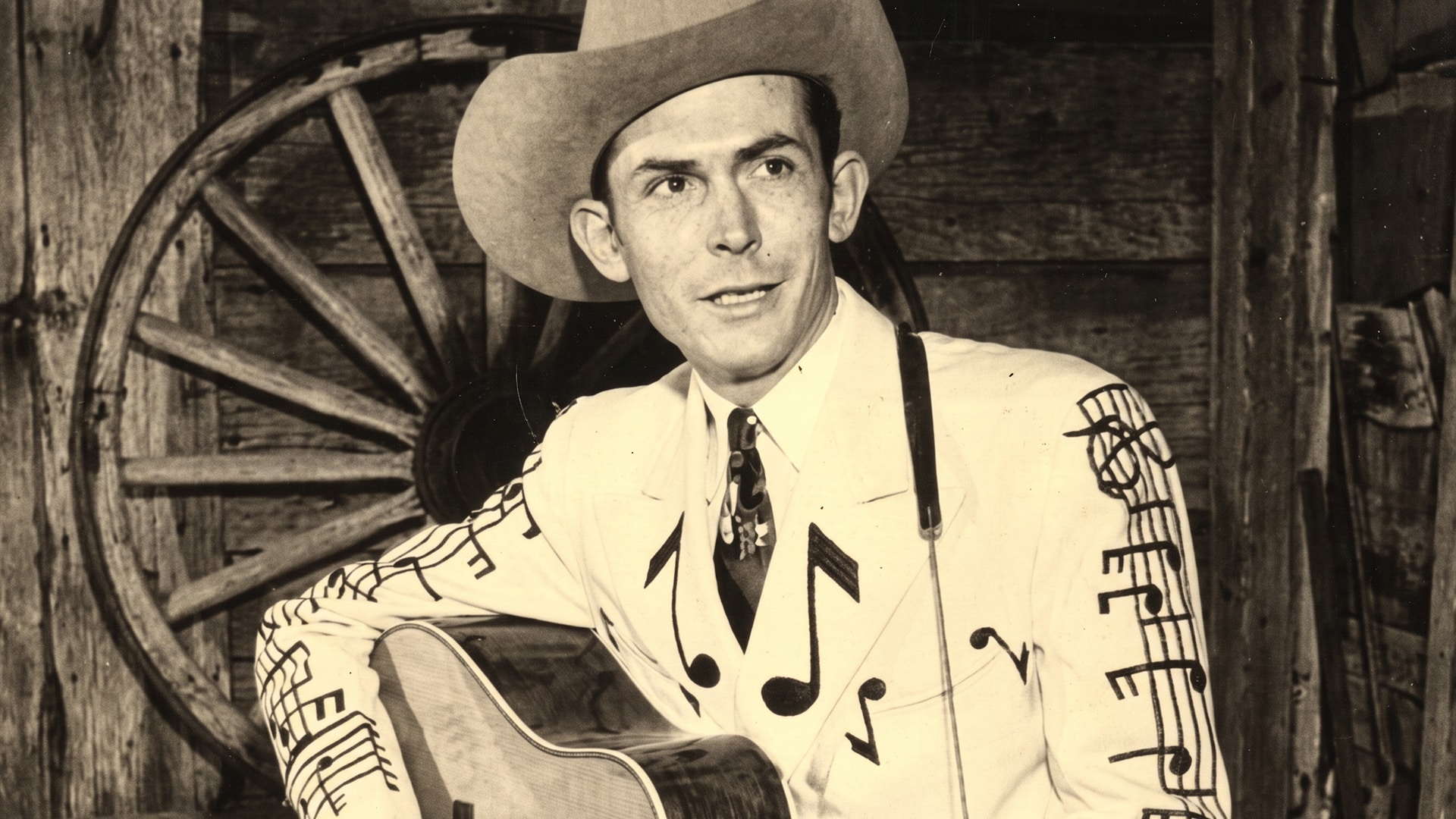


The last single Hank Williams released in his lifetime was called “I’ll Never Get Out of This World Alive.”
It came out on Nov. 21, 1952, and it was still on the radio when he died in the back seat of his own 1952 Cadillac, on the way to a New Year’s Day concert in Canton, Ohio.
He was found dead in that car in Oak Hill, West Virginia, on Jan. 1, 1953, when Charles Carr, the family friend driving him, stopped for gas, according to the West Virginia Encyclopedia. Hank Williams was 29 years old.
The story of that ride starts months earlier, with a career in trouble while his records kept climbing.
Hank Williams Cut His Last Single the Same Summer the Opry Fired Him
Hank Williams was still a hitmaker in 1952. “Jambalaya (On The Bayou)” spent fourteen weeks at No. 1 on the Billboard Country & Western chart that year, Classic Country TV notes.
Behind the hits, his life was coming undone. Back trouble, prescription drug abuse, alcoholism and unreliability caught up with him, and on Aug. 11, 1952, the Grand Ole Opry fired him for drunkenness. His band broke up, and the Louisiana Hayride took him back. By late that year he was thin and frail and had lost most of his hair.
Even so, the Opry was reportedly close to reinstating him when he died.
Two months before the firing, on June 13, 1952, he went into Castle Studios in Nashville to record a song he had written with Fred Rose. It was called “I’ll Never Get Out of This World Alive,” and Don Helms, Jerry Rivers and Chet Atkins played behind him. Atkins later remembered what happened after every take.
“We recorded ‘I’ll Never Get Out of this World Alive’ and after each take, [Hank had to] sit down in a chair. I remember thinking, ‘Hoss, you’re not jivin’,’ because he was so weak that all he could do was just sing a few lines, and then just fall in the chair.”
Atkins was describing a man who could not stand through his own song.
The record came out on Nov. 21, 1952, the last single released in his lifetime. It went to No. 1 after his death, and “Kaw-Liga” and “Your Cheatin’ Heart” also became posthumous No. 1 hits in 1953, Classic Country TV notes.
Who Was Driving the Car When Hank Williams Died?
Charles Carr, a family friend, was driving when Hank Williams died, according to the West Virginia Encyclopedia. He was driving Williams to the New Year’s Day show in Canton.
Williams left his mother’s boarding house in Montgomery, Alabama, on Dec. 30 for four holiday concerts. He was booked to play a New Year’s Eve show in Charleston, West Virginia, but bad weather stopped his flight from Knoxville, Tennessee, and he never made it.
He was given morphine for his back pain along the way, including from a doctor in Knoxville. That night the two of them left Knoxville by road, and Carr carried him out to the Cadillac at about 11 p.m.
In Tennessee, an officer named Swan H. Kitts pulled the Cadillac over. Kitts said the passenger in the back seat looked dead. Carr told him Hank was sleeping and paid the speeding fine.

For You
Carr did not drive every mile himself. In Bluefield, West Virginia, they picked up a relief driver, Don Surface, who drove only briefly.
Carr rarely spoke about the trip in the years that followed, though he gave an interview for the Hank Williams Museum in 2009, Pollstar reported.
Hank Williams Was Found Dead in Oak Hill, West Virginia, on New Year’s Day 1953
Hank Williams died in the back seat of the Cadillac while he was being driven, and he was found when Carr stopped for gas in Oak Hill. He was pronounced dead there in the early hours of Jan. 1, 1953, and his body was taken to the Pettit Funeral Home in town.
A coroner’s inquest in Oak Hill listed the cause of death as acute right ventricular dilation, acute cerebral edema and acute alcoholism. The official cause has also been reported as heart failure.
The drinking that cost him his place on the Opry stage in August 1952 is written right into the record of how he died.
The Pettit Funeral Home still stands, Alley 61 notes, and a historical marker near the highway acknowledges what happened in Oak Hill. His fans dedicated a plaque of their own in the town.
“On January 1, 1953, in Oak Hill, West Virginia, Hank Williams Sr. made his last stop on his last tour. This memorial is dedicated by his fans who wish to keep his memory and music alive forever.”
Oak Hill was only a gas stop on the way to Canton, and it became the town that keeps that New Year’s Day for him.
Hank Williams Went Home to Montgomery, Where Thousands Came to His Funeral
Hank Williams was an Alabama boy from the start. He was born Hiram King Williams in Mount Olive on Sept. 17, 1923, according to the West Virginia Encyclopedia, and it was Montgomery that gave him his funeral.
The service was held on Jan. 4, 1953, at the Montgomery Municipal Auditorium, and it drew thousands, Classic Country TV reports. Roy Acuff sang “I Saw the Light” for him, according to Classic Country TV.
The Cadillac took much longer to come back. Known as the Death Car, the 1952 Cadillac Hank Williams died in returned to Montgomery on Feb. 8, 1999, Roadside America reports, and it is the centerpiece of the Hank Williams Museum there. Fans who ask what happened to that car can find it in the same city where his last trip began.
On Dec. 30, 1952, Hank Williams left his mother’s boarding house in Montgomery for four holiday shows, with a song called “I’ll Never Get Out of This World Alive” on the radio. The song went to No. 1 after he was gone, and the 1952 Cadillac that carried him on his last ride now waits in Montgomery for the fans who still come looking for Hank Williams.
Know someone who loves Hank Williams?
Pass this story along to your friends and family on Facebook.